SORO Learning Studio
← All selected work
Selected work
Learning design / Fifth-grade mathematics

From directions to independence.

A fifth-grade volume project became a chance to design for planning, critical thinking, and a learner’s growing ownership of the work.

Assignment demands

Support the process without taking over the thinking.

The assignment required a learner to plan, construct, measure, calculate, and check several rectangular prisms. The design need included managing the sequence and initiating the work alongside understanding volume.

The volume project

Make the thinking visible.

One hands-on build. Several rectangular prisms. A path from “what do I do?” to measuring, calculating, constructing, and checking.

The assignment asked for a finished object. The design challenge was helping a learner manage everything it took to get there.

My design work: break the task into usable stages, make checks visible, connect the calculations to the physical build, and leave the reasoning with the learner.

Scaffolds in the learning process

Make the next step usable.

The staged guide responds to the planning and task-management demands visible in the work. Smaller work periods, a measurement record, and self-checks make the process easier to locate while preserving the learner’s responsibility for the mathematics.

The available artifacts document the design response and completed build. They do not constitute a formal usability-study dataset or a measured change in independence.

The design response

What the school gave us. What I built from it.

The school’s brief set the goal: make an animal from boxes and calculate its volume. I turned that brief into a learner-facing path with a plan, measurement record, staged build, and final checks.

Cleaned scan of the original fifth-grade volume-project assignment
Starting pointA cleaned scan of the school’s original assignment. View the unedited photograph ↗
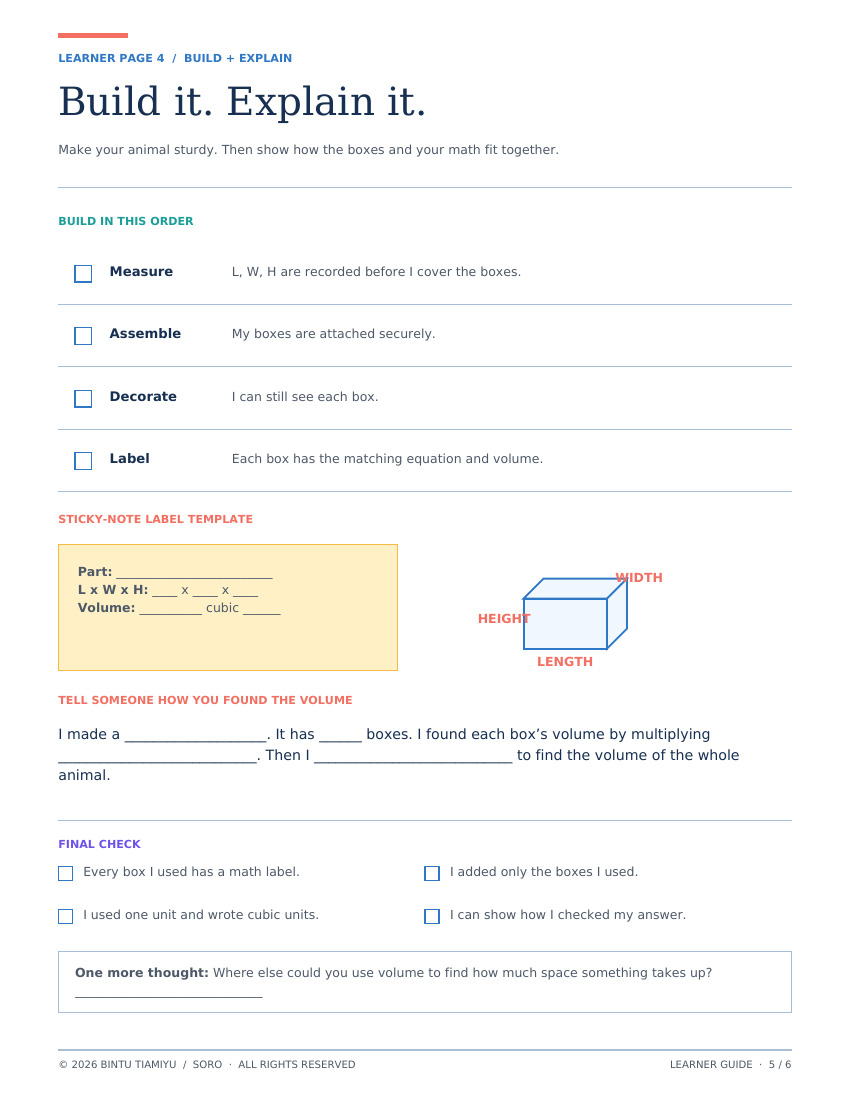
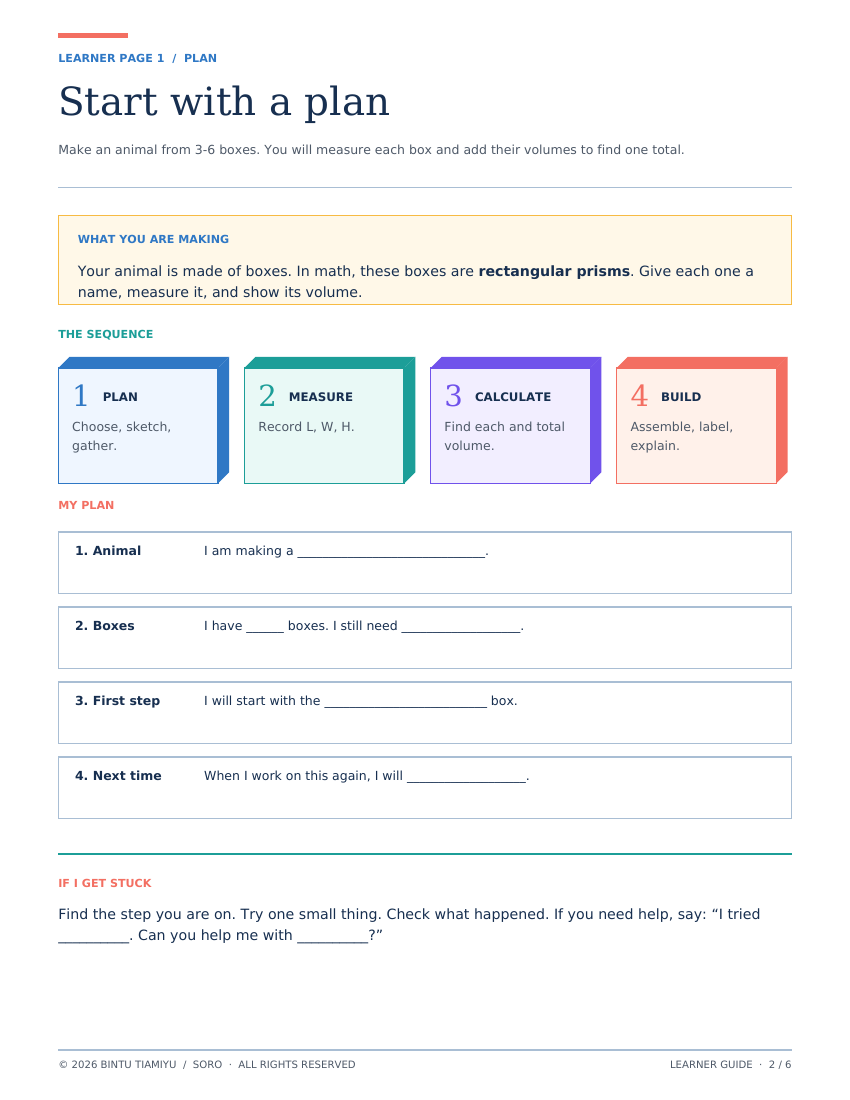
Page 1 of the redesigned learner guide, with a four-day planPage 2, planning the animal and materialsPage 3, measuring and calculating the volume of each partPage 4, building, explaining, and self-checking
Designed supportFour learner-facing pages for planning, sketching, measuring, and explaining, with an educator-facing design overview in the complete guide.View the complete guide ↗
Finished student artifact

A dinosaur built from rectangular prisms.

The completed green cardboard dinosaur brought the math into the room. The fifth-grade learner measured its component shapes and attached L × W × H calculations to the build. Across the project, the learner developed a thorough understanding of volume and applied it to each part of the finished build. The staged process supported independent starts, sustained work, and self-checking.

The project was completed across multiple work periods, with supports designed to reduce overwhelm while keeping the mathematical demand intact.

Implications for teaching

Make the process visible.

When an assignment combines several demands, separate the work into usable stages, provide a place to record thinking, and make self-checks available. Explore the guide to see those supports alongside the original assignment and completed learner work.

Open the learner guide ↗

Keep exploring

Sensory differences in virtual learning

← All selected work